
The UK government has committed to net zero by 2050, and construction must act early because it is one of the largest contributors to UK emissions. The built environment is responsible for around 25% of the UKs total carbon emissions, being the second largest source of emissions after transport so heavy focus will be put into how to transform this sector away from fossil fuel use.
The Construction Leadership Council (CLC) has set a target to cut diesel use on construction sites by 78% by 2035, through its Zero Diesel Sites Route Map. Electrification and hydrogen will play a heavy role in building and bridging gaps to fulfil this target for the construction industry.
HVO has become the industry's bridge fuel away from diesel, and it will help hit these targets. But it does not remove emissions entirely. To reach truly zero-emission sites, construction needs cleaner alternatives it can rely on long term. The two leading options are electric and hydrogen powered plant.
Electric plant: where it stands today
Electric plant is already a practical choice for some sites. It suits urban sites and indoor work where there is a grid connection and strict rules on noise and emissions.
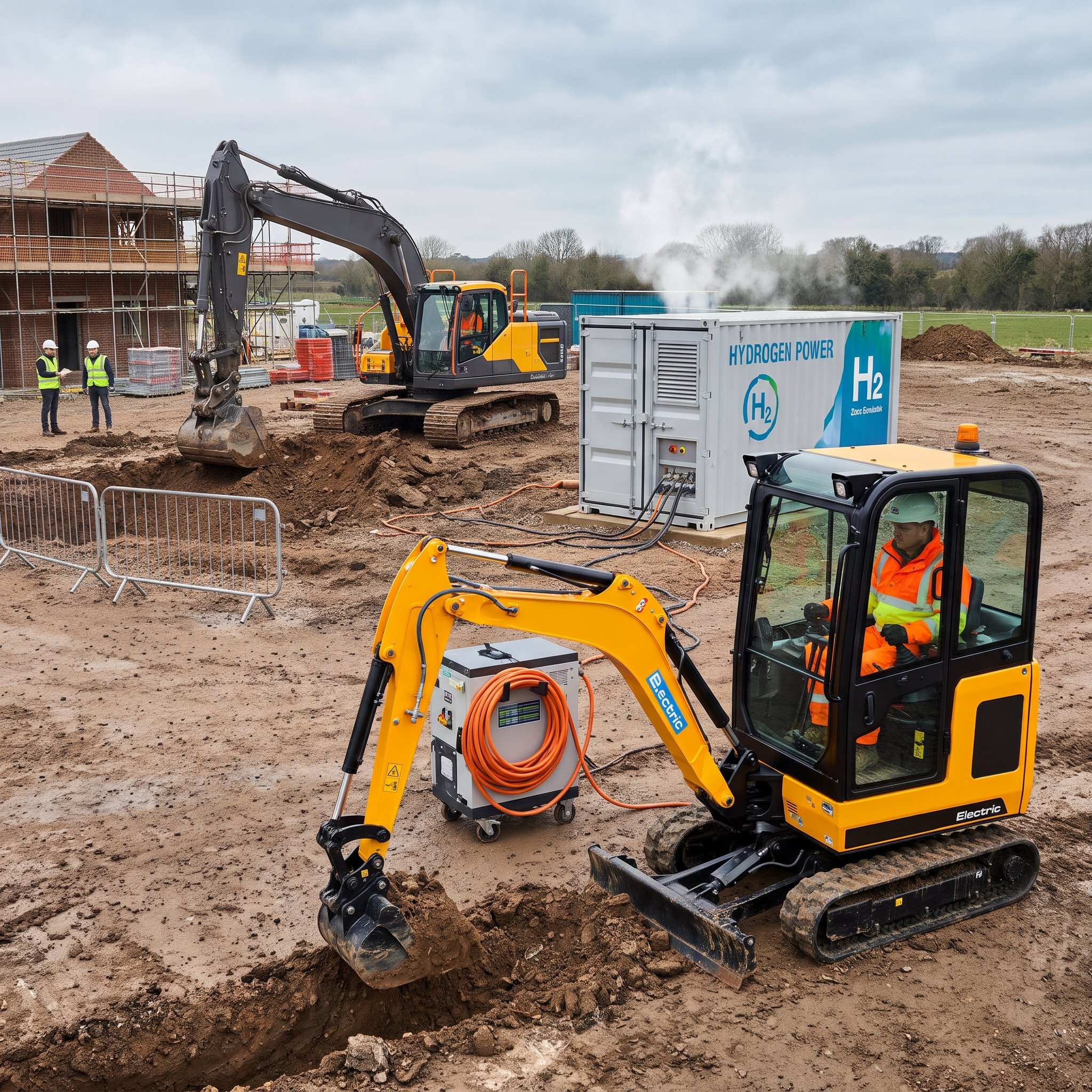
Most progress has been made with smaller machines, including mini excavators, telehandlers, dumpers and access platforms. JCB is selling the most established electric mini excavator with a full battery charge you can work for 5 hours costing £28,750. Machines such as big excavators and dozers need far more energy, which makes batteries heavy and expensive. The Volvo EC230 electric excavator is one of the larger electric machines commercially available with only 4-5 hours of work time, this machine has already been trailed by Chepstow Plant on a live UK project the Bristol Airport Public Transport Interchange.
Battery life is the main limitation. Some of the best machines are set to work for around 7 to 9 hours on a charge and take 8 to 12 hours to recharge. This fits a single day shift with overnight charging, but no longer or double shifts.
Electric plant also has lower running and maintenance costs, with fewer moving parts and no engine oil or filters.
Charging and power on site
Charging is one of the biggest practical barriers to electric plant. Many sites, especially for groundworks and earthworks, are remote and start before any power infrastructure is in place.
Time is also a problem. Machines need long hours to charge but have limited time available outside working hours, so moving plant to and from charging points wastes valuable time.
Rapid chargers and large generators can help, but they are expensive and still developing, so they are not yet practical for everyday use. Construction battery charging units with 240kw and 540Wh of battery size can cost over £250,000 to purchase. Highlighting its unfeasible for everyday commercial use for businesses right now.
Several newer solutions could make on site charging easier:
Battery energy storage units: large mobile batteries that store power and charge machines on site, without a grid connection.
Solar and wind hybrid systems: renewable generation that tops up site batteries.
Mobile charging packs: portable units brought to the machine, avoiding the need to move plant.
Hydrogen generators: covered in the next section.
Hydrogen options
Hydrogen is an important part of the road to net zero, but it is best seen as a supporting option. It is most useful where electrification is difficult or impractical, such as heavy machines and remote sites. There are three main ways hydrogen can be used in construction.
Hydrogen generators (fuel cells). This is where the strongest near term potential lies. A hydrogen fuel cell generator produces electricity on site, with water as its only emission. It can recharge electric machines overnight, so they are ready to work during the day. This makes hydrogen a good fit for rural sites without a grid connection, exactly where electric plant falls short.
Dual fuel hydrogen and diesel engines. Existing diesel machines can be converted to run on a mix of hydrogen and diesel. If hydrogen runs out, the machine keeps running on diesel alone. This offers a practical transition, since diesel engines are already in fleets. Dual fuel excavators have been used on live UK projects, supported by mobile hydrogen refuelling.
Pure hydrogen combustion engines. These burn hydrogen in place of diesel. They are still at an early stage, and there are concerns about whether they deliver the power and engine speed needed to drive hydraulics.
Hydrogen challenges
Hydrogen has not yet matured enough for widespread use in construction.
Cost. Converting a machine to dual fuel can add 20 to 30% to its cost.
Green vs grey hydrogen. Hydrogen is only low carbon if it is made using renewable electricity (green hydrogen). Most hydrogen today is made from natural gas (grey hydrogen), which produces significant emissions. In the UK evidence suggests over 80% of hydrogen comes from grey sources. A hydrogen excavator is only as green as the hydrogen supplied to it.
Regulation and standards. Clear guidance and regulations for using hydrogen in construction plant are still developing, which slows down widespread use.
Transport and storage. Hydrogen is difficult to transport and store, needing high pressure tanks and strict safety controls. This is especially challenging on rural sites, which also need space to store generators and batteries.
Market resistance. The industry is still built around diesel, and clients often decide whether change happens as they can block it or push it forward. Even so, the direction of travel is clear. Zero diesel sites with zero emission plant are the long term goal, so the question is not whether change will come, but what form it will take.
Comparing the options
| Diesel | HVO | Electric | Hydrogen | |
|---|---|---|---|---|
| Upfront cost | Lowest | Same machines as diesel | High | Highest: dual fuel conversion adds 20 to 30% |
| Fuel or running cost | Baseline | Premium over diesel | Lower running and maintenance costs | High |
| Carbon emissions | Highest | Up to 90% lower lifecycle emissions | Zero tailpipe; depends on electricity source | Zero tailpipe (fuel cell); depends on green or grey hydrogen |
| Air quality and noise | Poor | Slightly better than diesel | Zero emissions, very quiet | Zero emissions (fuel cell) |
| Availability | Everywhere | Good, but supply limited | Growing, mainly small machines | Very limited, mostly trials |
| Refuelling or charging | Minutes | Minutes, same as diesel | Varies: 4 to 12 hours | Minutes, but few refuelling points |
| Best suited to | All machines | All existing diesel machines | Small plant, urban and indoor sites | Remote sites, site power |
The role of plant hire companies
Most contractors hire much of their plant rather than owning it, so hire companies will largely decide how quickly electric and hydrogen machines reach sites.
Hire firms are under growing pressure to invest in zero emission fleets. However, they typically replace machines every 5 to 7 years, so the switch will be gradual and phased. New electric and hydrogen machines also cost more, and hire firms need confidence that customers will hire them at a higher rate.
Government funding is available to support the transition, but applying for grants takes time. Local authorities around net zero and decarbonisation are launching grants to fund and support these kinds of transitions.
Conclusion: mixed future
No single solution will replace diesel across construction. A mixed fuel future is most likely, with the right choice depending on the machine and the site. Each location has its own constraints, from grid access and noise rules to how remote it is.
Electric plant might lead on smaller machines and urban sites where as hydrogen is likely to support heavy plant and remote sites, both directly and by powering electric machines. HVO will most likely continue to bridge the gap for existing diesel fleets.
Talk to our team
Churngold recognises the importance of a fossil fuel free future. We are committed to reducing carbon emissions across operations and working collaboratively with clients to explore cleaner alternatives. We constantly horizon scanning for new technologies coming into the industry and support the future road map of zero carbon technologies. Please get in touch with our team to discuss how we can support your goals and development of new technologies.