
Brownfield Remediation process explained: From site investigation to sign-off
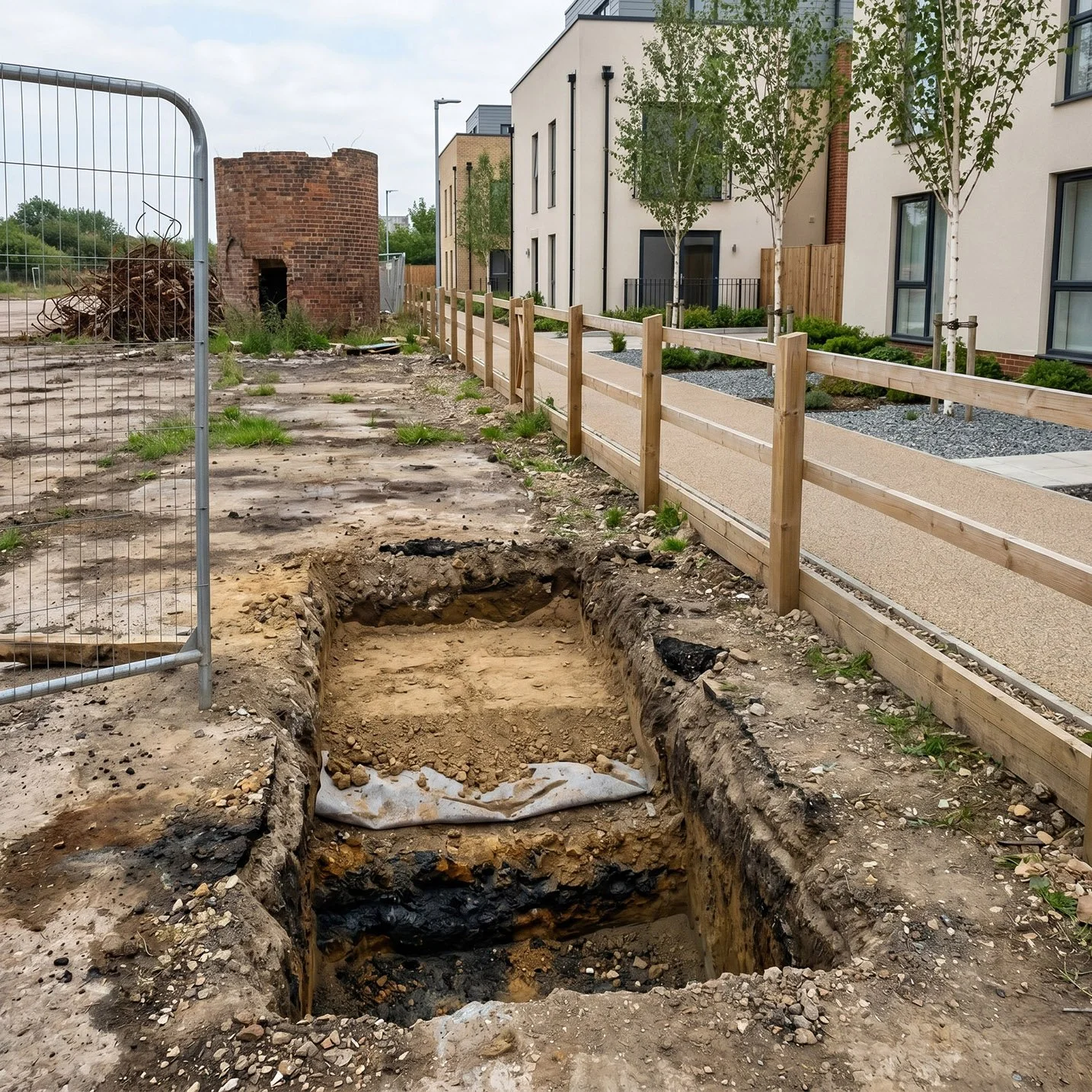
Brownfield remediation often decides whether a development hits its programme and budget, or breaks both.
A misjudged remediation strategy can add six-figure sums and months of delay to a scheme that looked viable on paper, and most of the damage happens before a single shovel goes in the ground.
So how does the process actually work, and where do developers most often get caught out?
What is Brownfield Remediation?
Brownfield remediation is the process of identifying, assessing, and treating contamination on previously developed land to make it safe and suitable for new use. It sits within the wider field of contaminated land remediation, which covers any site where past land use has left a contamination legacy that needs managing before redevelopment.
The push toward brownfield-first development under the National Planning Policy Framework has put more of these sites in front of developers than ever, but the easy ones are largely gone. What remains is land with genuine contamination challenges: former industrial use, fuel storage, asbestos in the building fabric, made ground of unknown origin, heavy metals, and hydrocarbons.
The process is governed by Part 2A of the Environmental Protection Act 1990 and overseen by the Environment Agency, with local authority Environmental Health teams discharging planning conditions on a site-by-site basis. Done properly, remediation transforms a contaminated liability into a developable asset. Done badly, it stalls schemes for months and erodes margin.
This article walks through the six stages of the process, what each one actually involves, and where the commercial risk sits at every step.
The Brownfield Remediation process at a glance
Most brownfield remediation programmes follow the same six stages, regardless of site size or contamination type. The level of detail varies. The sequence does not.
| Stage | Purpose | Typical Duration | Who Leads | Cost Driver |
|---|---|---|---|---|
| 1. Phase 1 Desk Study and Site Walkover | Identify potential contamination and pollutant linkages from historical and regulatory data | 2 to 4 weeks | Environmental consultant | Site complexity and historical use |
| 2. Phase 2 Intrusive Site Investigation | Quantify contamination through sampling, monitoring, and lab analysis | 4 to 8 weeks | Ground investigation specialist | Sample density, depth, and analysis scope |
| 3. Risk Assessment and Remediation Strategy | Translate data into action plan against agreed performance criteria | 2 to 6 weeks | Environmental consultant | Contamination complexity and end use |
| 4. Regulatory Approval and Planning Discharge | Secure local authority and Environment Agency sign-off on the strategy | 4 to 12 weeks | Developer with consultant support | Regulator workload and consultation scope |
| 5. Remediation Works | Deliver excavation, treatment, and disposal against the strategy | Highly variable (weeks to many months) | Specialist remediation contractor | Volume, contamination type, disposal route |
| 6. Validation and Sign-Off | Confirm performance criteria met and discharge planning conditions | 2 to 4 weeks | Environmental consultant with regulator | Sample density and end-use criteria |
Each stage feeds the next. Cutting corners in the first three stages does not save money. It pushes cost and risk into the remediation works, where it is harder and more expensive to resolve.
Stage 1: Phase 1 Desk study and site walkover
Phase 1 is where the picture of the site is built before anyone breaks ground. It combines historical map research, environmental data review, regulatory record searches, and a physical site walkover into a single document called the Phase 1 Preliminary Risk Assessment.
The purpose is to identify potential contaminants and what is known as pollutant linkages: the connections between a source of contamination, a pathway through which it could move, and a receptor that could be harmed. Without a credible Phase 1, no responsible regulator, lender, or main contractor will let a project move forward.
A typical Phase 1 will cover:
Historical Ordnance Survey mapping going back to the earliest available records
Environment Agency contamination and pollution incident data
Local authority records on past industrial use and waste licences
A site walkover to identify visible signs of contamination, structures, and surrounding land use
A conceptual site model summarising the contamination risk picture
What developers often miss at Phase 1
The most common Phase 1 oversights are predictable. Incomplete historical research that misses a short period of high-risk industrial use. Off-site sources of contamination that drift onto the site through groundwater. Made ground that is treated as a single layer when it actually contains decades of mixed materials at varying depths. And on any site with wartime industrial activity, the unexploded ordnance risk that is too often deferred to later stages when it should be flagged at Phase 1.
A thorough Phase 1 is the cheapest insurance a developer will ever buy on a brownfield site.
Stage 2: Phase 2 Intrusive Site Investigation
Phase 2 is where the desk study turns into hard data. Trial pits, boreholes, soil sampling, groundwater monitoring wells, ground gas monitoring, and laboratory analysis all combine to give a quantitative picture of what is actually in the ground.
Sample density and depth are driven by three things: the site's history, the intended end use, and the findings from Phase 1. A residential scheme on a former gasworks needs more sampling than a commercial warehouse on a long-vacant site, and the data must be defensible against regulator scrutiny.
Phase 2 work in the UK is governed by BS 5930 (the code of practice for ground investigations) and BS 10175 (the standard for investigation of potentially contaminated sites). The specialist consultants delivering this work comply with these standards as part of their core practice. A Phase 2 that does not reference them risks rejection by the regulator and rework at the developer's cost.
Why GI underspend is a false economy
The temptation to cut Phase 2 scope to save budget early is the most expensive mistake in brownfield development. Insufficient sampling means the remediation strategy is built on incomplete data, which means cost and programme uncertainty. A few thousand pounds saved at investigation routinely translates into hundreds of thousands of pounds of unexpected disposal costs, programme overruns, or claims at remediation works.
If a Phase 2 quote looks suspiciously cheap, it almost always is.
Stage 3: Risk assessment and remediation strategy
Once the data is in, the Quantitative Risk Assessment translates it into something developers and regulators can act on. The assessment uses the source-pathway-receptor model to test whether each identified contaminant poses an unacceptable risk under the site's intended end use, comparing concentrations against generic and site-specific assessment criteria.
A remediation strategy is the document that sets out what will be done about it. It identifies which contaminants need treatment, selects the techniques to be used, defines the performance criteria each treatment must achieve, and lays out the validation plan that will prove success at sign-off.
The technique selection matters more than most developers realise. Options range across:
Excavation and disposal to licensed landfill, the simplest but often the most expensive
On-site treatment, including bioremediation, chemical oxidation, soil washing, and stabilisation
Capping and containment, where treatment is impractical and exposure can be reliably blocked
Monitored natural attenuation, suitable for a narrow set of cases involving groundwater
End use is the dominant variable. Residential development drives the most stringent criteria, commercial and industrial less so. The same contamination level can demand different strategies depending on whether the end product is family housing or a logistics shed.
| Technique | Best For | Limitations | Cost Band |
|---|---|---|---|
| Excavation and disposal | Localised hotspots, smaller volumes, time-critical programmes | Disposal costs scale with tonnage; landfill tax exposure on hazardous classification | Medium to high |
| Bioremediation | Hydrocarbons and biodegradable contaminants on larger sites | Slower than mechanical methods; weather and temperature dependent | Low to medium |
| Chemical oxidation | Targeted treatment of hydrocarbons and chlorinated solvents | Requires precise contaminant characterisation; not suitable for all matrices | Medium |
| Soil washing | Heavy metals and segregable contamination in granular soils | Less effective on cohesive soils; generates concentrated residues | Medium to high |
| Stabilisation | Heavy metals where excavation is impractical or uneconomic | Long-term monitoring obligations; not always accepted by regulators for sensitive end uses | Low to medium |
| Capping and containment | Large volumes where treatment is impractical; non-residential end uses | Imposes long-term land use restrictions; limits future site flexibility | Low |
A good remediation strategy gives developers options, costs, and a credible route to sign-off. A bad one names a single technique without justifying why.
Stage 4: Regulatory approval and planning discharge
This is the slowest stage, and the one that catches developers off guard most often. The remediation strategy must be approved by the local authority's Environmental Health team and, where the contamination affects controlled waters, by the Environment Agency. Both will consult on the document, raise queries, and require revisions.
The approval feeds directly into planning discharge. Most brownfield schemes carry a planning condition along the lines of "no development shall commence until a remediation strategy has been submitted to and approved in writing by the local planning authority." Until that condition is discharged, no meaningful works can start.
Early engagement is the single biggest lever a developer has at this stage. Strategies that have been informally reviewed by the regulator before formal submission move through the system far faster than those submitted cold. The principle is the same one we cover in our Early Contractor Involvement article: the cheapest hours on a brownfield project are the ones spent talking to the right people before commitments are made.
The discharge trap
The most common scenario we see is a developer who has bought a site, secured planning, and discovered after the fact that the conditions require remediation strategy sign-off before any meaningful works can begin. Approval can take three months. On a tight programme, that is the difference between hitting and missing a financial year-end.
Stage 5: Remediation works
This is where the strategy meets the site. Remediation works are typically the largest single cost on a brownfield programme and the stage with the most operational complexity.
Site setup comes first: hoarding, dust and noise mitigation, waste management plans, and environmental monitoring stations. None of this is glamorous, but it determines whether the works run cleanly or generate complaints, regulator visits, and stop notices.
Excavation and load-out logistics dominate the cost on most schemes. The volume of contaminated material moving off site, its hazardous waste classification, and the disposal route together account for the majority of the budget. Hazardous waste classification under the List of Wastes Regulations and duty of care under the Environmental Protection Act 1990 are non-negotiable. The technical work of sampling, lab analysis, and classification is led by specialist supply chain partners, including tip owners, hauliers, and ground engineering consultants. The contractor coordinating the works is responsible for ensuring this is done correctly, because mistakes at this stage create regulatory exposure that follows the developer for years.
Reuse of soil on site, where contamination allows, is one of the few genuine cost levers available. The CL:AIRE Code of Practice for the Definition of Waste in Development Industry Code of Practice provides the legal framework for treating excavated material as a resource rather than a waste. A well-run Materials Management Plan can take six-figure sums out of a programme.
On-site treatment is rarely a single-track operation. Some contamination types lend themselves to in-situ or on-site treatment: bioremediation of hydrocarbons, for example, can run alongside other site activity with minimal disruption. Other treatments are specialist facility operations: soil washing for heavy metals typically means transporting contaminated material to an off-site treatment plant, then bringing the cleaned material back to site for use as engineered fill. The contractor's job is to plan and coordinate the right combination for the site, working with treatment specialists where the technique demands it.
Live monitoring runs throughout the works: ground gas, vapour, water, and dust readings give early warning of issues and provide the audit trail regulators expect. The contractor's site team operates this monitoring directly, with specialist equipment brought in where the parameters demand it.
Churngold's role at this stage
Direct delivery of bulk excavation, materials handling, and earthworks using GPS-guided plant and 3D machine control
In-house implementation of Materials Management Plans under the CL:AIRE Code of Practice, with third-party verification at sign-off provided by independent specialists
In-house bioremediation where the contamination type and site conditions allow, alongside coordination of specialist off-site treatment for techniques such as soil washing
Direct delivery of live environmental monitoring (ground gas, vapour, water, dust) using specialist equipment brought in where required
Coordination of hazardous waste classification, transport, and disposal through licensed supply chain partners (sampling and lab analysis led by specialist consultants)
Stage 6: Validation and sign-off
Validation is the stage that determines whether everything before it is recognised by the regulator. It is also the stage developers most often underestimate in time and cost.
The work involves confirmatory sampling and post-remediation testing against the performance criteria agreed in the remediation strategy. Where soil has been treated, samples must show that contamination has been reduced to acceptable levels. Where soil has been removed and replaced, the new material must be tested. Where capping has been used, the cap's integrity and the conditions beneath it must be verified.
The validation report pulls all of this together into a single document for regulator review. Local authorities expect a clear narrative tying the original contamination, the strategy, the works carried out, and the post-works data into one defensible record. A weak validation report can trigger requests for additional sampling, additional testing, and in the worst cases additional remediation works.
When the regulator is satisfied, the planning condition is formally discharged. The site moves from contaminated to remediated in the planning record, and the validation report becomes part of the site's permanent file. Developers should retain it indefinitely. It will be requested at every future sale, refinancing, or change of use.
What drives the cost of Brownfield Remediation
Brownfield remediation costs vary enormously between sites, but the variables are predictable. Understanding them is the difference between a credible budget and a number pulled from the air.
The dominant cost driver on most schemes is the volume of contaminated material to be handled. Disposal costs scale linearly with tonnage, and contamination depth on made ground sites is routinely underestimated until the trial pits go in.
Contamination type and concentration drive the second largest variable. Hazardous waste classification can multiply disposal costs by a factor of three or four compared to non-hazardous material. A site with mixed contamination needs careful segregation to avoid unnecessary uplift to hazardous classification across the entire spoil volume.
Treatment versus dig-and-dump is a long-term cost trade-off rather than a one-off decision. On-site treatment carries higher mobilisation costs but lower disposal costs, and works best on larger sites with higher contamination volumes. Smaller sites with isolated hotspots usually favour excavation and disposal.
Site constraints matter more than developers expect. Urban sites with restricted access, third-party party walls, or live services running through the works area can double handling costs compared to open greenfield-style remediation. Programme pressure has the same effect: accelerated remediation typically costs more, both in plant resources and in disposal premiums.
Two often-overlooked factors round out the picture. Validation requirements scale with the stringency of the end-use criteria, with residential schemes requiring more confirmatory sampling than industrial. And Land Remediation Relief, the UK tax relief that offsets eligible remediation costs against corporation tax, is missed on a striking number of schemes despite being available to most developers.
The article does not give specific cost figures because they date quickly and vary by site. Any contractor who quotes a £/m³ rate without seeing the data is guessing.
When to involve Churngold
The right time to bring a remediation contractor into a brownfield scheme is earlier than most developers do. The practical triggers are:
Pre-purchase due diligence.A contractor's view on remediation feasibility before site acquisition can save a developer from buying a problem they cannot solve at a price that makes the scheme viable.
Post-purchase, pre-planning.Remediation strategy input at this stage strengthens the planning submission and reduces the risk of conditions being attached that later derail the programme.
Post-planning, pre-works.Detailed cost and programme planning, supply chain mobilisation, and pre-construction logistics are where the right contractor adds the most measurable value.
Active remediation.Full delivery of bulk excavation, earthworks, and materials management for sites already through approval.
For developers planning a brownfield scheme, our Pre-Construction Pack covers the site preparation, remediation, and enabling works decisions that shape cost and programme.
Linked Services
For more on the surrounding scope of work, see our pages on Land Remediation, Earthworks, and Enabling Works. For deeper reads on the planning side of brownfield programmes, our articles on Cut and Fill Earthworks, Enabling Works Planning, and the Early Contractor Involvement piece in the Pre-Construction Planning Series cover the decisions that shape outcomes before remediation begins.
Frequently Asked Questions
How long does brownfield remediation take?
The full process, from Phase 1 through validation, typically runs six to eighteen months on most UK brownfield sites. Smaller sites with limited contamination can complete faster. Sites with complex contamination, regulatory disputes, or planning condition complications can take significantly longer. Regulatory approval is usually the slowest stage rather than the works themselves.
What is the difference between Phase 1 and Phase 2 site investigation?
Phase 1 is a desk-based assessment combining historical research, regulatory data, and a site walkover to identify potential contamination and pollutant linkages. Phase 2 is the intrusive investigation that turns Phase 1's hypotheses into hard data through soil sampling, boreholes, gas monitoring, and laboratory analysis. Phase 1 identifies what to look for. Phase 2 confirms what is actually there.
What is a remediation strategy and who writes it?
A remediation strategy is the document setting out which contaminants need treatment, what techniques will be used, what performance criteria they must achieve, and how success will be validated. It is typically written by a specialist environmental consultant and reviewed by the local authority and, where relevant, the Environment Agency. The remediation contractor delivers against it.
Can contaminated soil be reused on site?
Yes, in many cases. The CL:AIRE Code of Practice for the Definition of Waste provides the legal framework for treating suitable excavated material as a resource rather than a waste. A Materials Management Plan documents the volumes, criteria, and reuse locations. Reuse can take significant cost out of a programme but requires careful contamination assessment and regulator engagement.
What is Land Remediation Relief and who qualifies?
Land Remediation Relief is a UK corporation tax relief that allows developers to claim 150% of qualifying remediation expenditure against taxable profits. It applies to companies remediating contaminated land they did not contaminate themselves. Most brownfield schemes qualify in part, but the relief is missed on a surprising proportion of projects because the claim must be made through the corporation tax return.
When should a developer engage a remediation contractor?
Earlier than most developers do. Pre-purchase due diligence is the highest-value engagement point: a contractor's view on whether a site is viable to remediate at a workable cost can prevent expensive acquisition mistakes. Post-purchase, contractor input into the remediation strategy helps shape a deliverable plan rather than a theoretical one.
Plan Your Brownfield Project With Confidence
Planning a brownfield development? Talk to Churngold's remediation team about your site.