
Enabling Works vs Groundworks: What’s the difference?
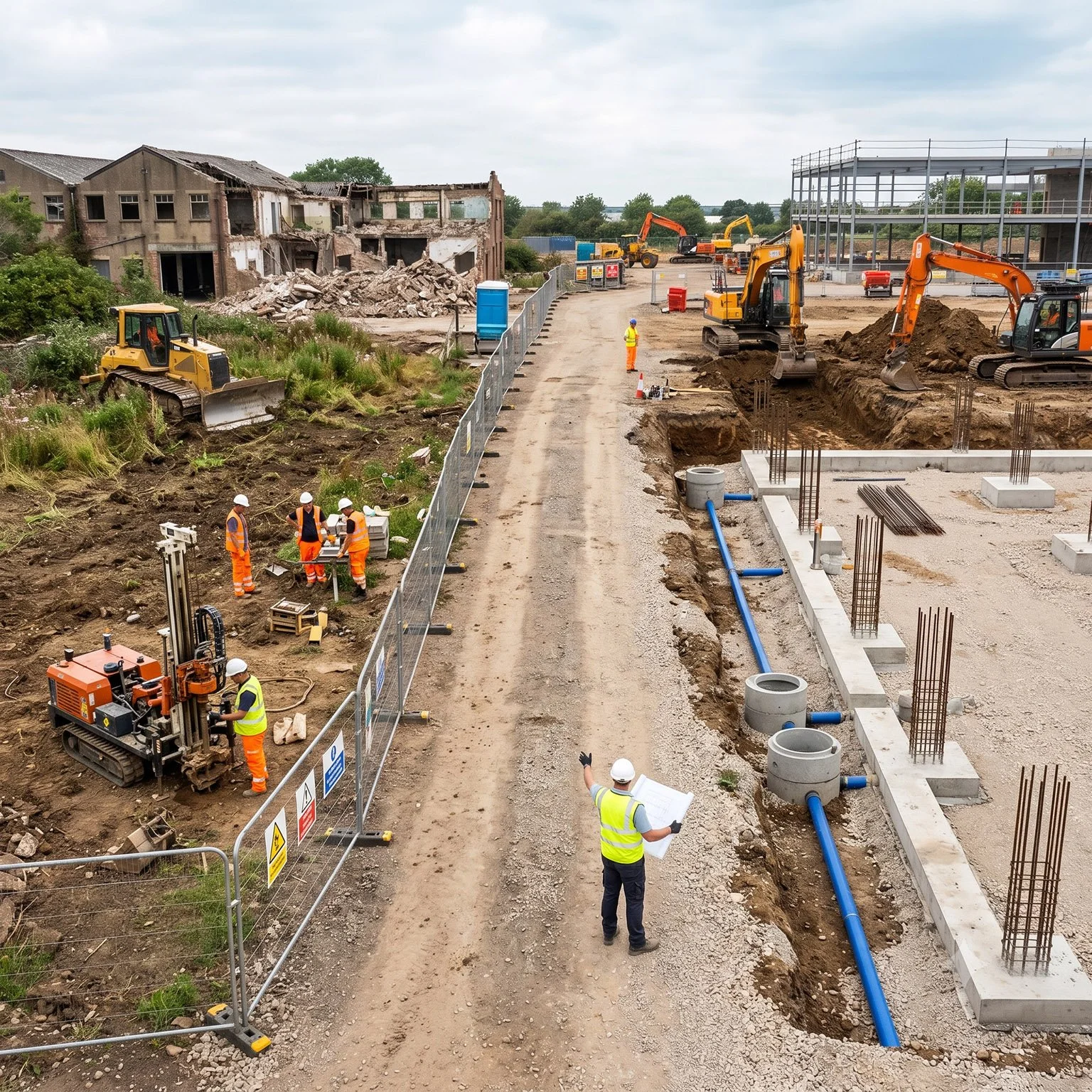
Two terms, two very different roles on a construction project. Get them confused, and your programme, your budget, and your procurement strategy all start on the wrong foot.
So what actually separates enabling works from groundworks? When does one end and the other begin? And does it matter if the same contractor delivers both?
This guide breaks it down clearly, covering what each involves, how they sit within the project timeline, and why understanding the distinction matters long before the first foundation is poured.
What are Enabling Works?
Enabling works are the preparatory activities carried out to make a site safe, accessible, and ready for construction to begin. They deal with everything that needs to happen before the main build programme can start.
On a simple greenfield site, this might mean little more than site clearance and temporary fencing. On a complex brownfield scheme, the enabling works package can run to twelve months or more and involve dozens of interdependent activities, each with its own regulatory lead time.
A typical enabling works package might include:
Site clearance and vegetation removal
Demolition of existing buildings and structures
Utility diversions, disconnections, and protection of live services
Ground investigation (Phase 1 desk study and Phase 2 intrusive surveys)
UXO (unexploded ordnance) risk assessment and clearance
Land remediation and contamination treatment
Ecological mitigation measures (newt fencing, bat roost relocation, habitat creation)
Construction of temporary access roads, haul routes, and piling mats
Hoarding, perimeter fencing, and site security
Discharge of pre-commencement planning conditions
The common thread is that enabling works remove risk. They clear obstacles, resolve unknowns, and create the conditions under which construction can proceed safely and without interruption.
Enabling works also tend to carry the highest level of regulatory engagement on a project. Planning condition discharge alone can take 8 to 12 weeks. Environment Agency consents for remediation or dewatering add further lead time. Miss these, and the main build sits idle regardless of how ready everything else is.
It is worth noting that the scope of enabling works is rarely fixed at the point of appointment. Ground investigation findings, unexpected contamination, or service clashes often expand the package as the site reveals its true condition. This is one of the reasons enabling works contracts tend to include provisional sums and re-measurable elements rather than fixed prices. The contractor who prices enabling works on assumptions without adequate survey data is the contractor who submits variations.
What are Groundworks?
Groundworks are the structural and civil engineering activities that form the physical base of a building or structure. Where enabling works prepare the site, groundworks create the foundations and below-ground infrastructure that the finished building relies on.
Groundworks typically begin once the enabling works package is complete and the site has been handed over as a clean, safe platform. The scope depends on the building type, the structural design, and the ground conditions revealed during the enabling works phase.
A typical groundworks package includes:
Bulk excavation to formation level
Foundation construction (strip foundations, pad foundations, piled foundations, raft slabs)
Below-ground foul and storm drainage installation
Ducting for electrical, telecoms, and water services
Ground stabilisation and soil improvement
Concrete substructures, lift pits, and retaining walls
Piling and ground anchor installation
Kerbing, footpaths, and external hardstanding
Service connections and meter installations
The risk profile of groundworks is different from enabling works. By the time groundworks start, the site should already be characterised, cleaned, and accessible. The remaining risks are structural and geotechnical rather than environmental or regulatory. That said, poor ground investigation during the enabling phase can leave nasty surprises in the ground that only emerge once excavation begins, which is exactly why getting the enabling works right matters so much.
Groundworks also have a more direct relationship with the structural design. The foundation type, drainage layout, and substructure detailing are all driven by engineering calculations that respond to ground conditions. Changes during groundworks, such as discovering weaker bearing capacity than the ground investigation predicted, can trigger redesigns that ripple through the superstructure programme and cost plan.
Key differences between Enabling Works and Groundworks
The simplest way to understand the distinction is this: enabling works make the site ready for construction. Groundworks build the base that construction sits on.
But the differences go deeper than timing and scope. The risk profile, the regulatory requirements, and the procurement approach are all different.
Table 1: Enabling Works vs Groundworks comparison
| Factor | Enabling Works | Groundworks |
|---|---|---|
| Purpose | Make the site safe, accessible, and ready for construction | Build the structural base and below-ground infrastructure |
| Timing | Before main construction begins | After enabling works, at the start of the main build |
| Typical scope | Site clearance, demolition, utility diversions, remediation, UXO, ecological mitigation, temporary access | Excavation, foundations, drainage, ducting, ground stabilisation, concrete substructures |
| Risk profile | High uncertainty: contamination, buried services, regulatory approvals, ecological constraints | Lower uncertainty once enabling works are complete; risks are structural and geotechnical |
| Regulatory focus | Planning condition discharge, Environment Agency consents, ecological licences | Building control approvals, structural engineer sign-off |
| Programme impact | Delays here push the entire project back before it starts | Delays affect the main build programme but the site is already accessible |
| Typical duration | Weeks to 12+ months on complex brownfield sites | Weeks to months depending on foundations and drainage scope |
| Who delivers | Specialist enabling works contractor or principal contractor with in-house capability | Groundworks contractor, often the same firm if capabilities overlap |
One important point: the boundary between the two is not always clean. Site clearance, for example, could sit in either package depending on how the contract is structured. Ground stabilisation might be considered enabling works on a contaminated site but groundworks on a clean one. The definitions are shaped by the project, the procurement route, and the contract.
What matters is that both packages are planned together, even if they are procured separately. Gaps between enabling works completion and groundworks mobilisation are where programmes unravel.
What does each package include?
The scope of each package varies by project, but the following gives a representative breakdown of the activities that typically sit within each.
Table 2: Scope breakdown
| Enabling Works Scope | Groundworks Scope |
|---|---|
| Site clearance and vegetation removal | Bulk excavation to formation level |
| Demolition of existing structures | Foundation construction (strip, pad, piled, raft) |
| Utility diversions and disconnections | Below-ground drainage and attenuation |
| Ground investigation and surveys | Ducting for services (electric, telecoms, water) |
| UXO risk assessment and clearance | Ground stabilisation and improvement |
| Land remediation and contamination treatment | Concrete substructures and retaining walls |
| Ecological mitigation (e.g. newt fencing, bat surveys) | Piling and ground anchors |
| Temporary access roads and haul routes | Kerbing, footpaths, and hardstanding |
| Hoarding, fencing, and site security | Service connections and meter installations |
| Discharge of pre-commencement planning conditions | External works and surface finishes |
On complex schemes, some items sit in the grey zone between the two packages. Ground investigation is a good example: the survey work is enabling, but the response to what the survey finds (stabilisation, piling, or foundation redesign) is groundworks. Clear scope definition at procurement stage prevents these grey areas from becoming disputes during delivery.
How Enabling Works and Groundworks fit into the project programme
On a straightforward project, the sequence is linear. Enabling works are completed in full, the site is handed over, and groundworks begin. The main build follows.
On larger phased developments, the picture is more nuanced. Enabling works might still be underway in one zone while groundworks have started in another. A housing scheme of 200+ plots, for instance, might release phases in blocks of 30 to 50, with enabling works running six to eight weeks ahead of the groundworks team.
This phased approach reduces the overall programme duration, but it introduces interface risk. If enabling works in Phase 2 are delayed, the groundworks team either sits idle or relocates, and both options cost money.
Early contractor involvement during the pre-construction phase is where this gets resolved. A contractor with experience across both enabling works and groundworks can map the interdependencies, flag lead times for regulatory approvals, and sequence the handover points to keep the programme moving.
Project Example: Temple Quarter Enterprise Campus, Bristol
Churngold delivered enabling works, earthworks, and civil engineering packages at the University of Bristol’s Temple Quarter campus. The city centre brownfield site required careful sequencing of enabling works across multiple zones, with deep drainage installation and temporary works running in parallel. Early contractor involvement during PCSA stage allowed Churngold to input on sequencing and buildability, helping the project team manage a challenging multi-stakeholder environment.
Should you appoint one contractor or two?
There is no single right answer here. It depends on the project, the procurement route, and the risk appetite of the client.
Separate contractors
Some developers prefer to appoint a specialist enabling works contractor to clear and prepare the site, then competitively tender the groundworks package once the site conditions are fully understood. This approach can work well on sites with significant remediation or demolition scope, where the enabling works contractor needs specialist experience that the eventual groundworks contractor may not have.
The drawback is interface risk. The handover between two contractors is a programme pinch point. If the enabling works overrun or the site is not left in the condition the groundworks contractor expected, disputes and delays follow.
Single contractor for both
Appointing a single contractor to deliver both packages removes the interface risk entirely. There is no handover, no gap in the programme, and a single point of accountability for the site from first entry to foundation completion.
This approach works best when the contractor has genuine capability across both enabling works and groundworks. A contractor who specialises in demolition and remediation but subcontracts all foundation work is not truly offering an integrated package.
There is also a commercial benefit. When one contractor owns both packages, they can manage the transition efficiently. If enabling works complete ahead of programme, the groundworks team can mobilise early. If an issue arises during enabling works that affects foundation design, the same team can adapt without a contract variation passing between two organisations. The programme becomes more resilient because the decisions stay within one delivery team.
Common mistakes when planning Enabling Works and Groundworks
1. Treating enabling works as a formality
Enabling works are where the unknowns live. Contamination, buried services, protected species, planning conditions that take longer than expected to discharge. Treating this phase as a box-ticking exercise before the real work starts is how projects lose weeks before the first foundation is poured.
2. Procuring groundworks before enabling works are scoped
If the groundworks tender goes out before the enabling works findings are known, the groundworks contractor is pricing on assumptions. When those assumptions turn out to be wrong (and on brownfield sites, they often do), the cost increases come through as variations.
3. Not planning the handover
Even when the same contractor delivers both packages, the transition from enabling works to groundworks needs to be planned. What condition will the formation be left in? What levels? What information gets passed to the groundworks team? A clean handover avoids rework.
4. Underestimating regulatory lead times
Planning condition discharge, ecological licence applications, Environment Agency permits for remediation or dewatering. These processes have fixed lead times that cannot be compressed. If they are not factored into the enabling works programme from day one, they become the critical path.
5. Separating the two packages in budget without connecting them in programme
Enabling works and groundworks are often budgeted as separate line items, which makes commercial sense. But they need to be programmed as a single sequence. A budget split without a programme connection means nobody owns the gap between the two, and that gap is where programme slippage hides.
How the site type affects the balance between Enabling Works and Groundworks
The relative weight of enabling works versus groundworks shifts dramatically depending on the site type.
Greenfield sites
On a clean greenfield site with no contamination history, no existing structures, and no significant ecological constraints, the enabling works package can be minimal. Site clearance, temporary access, and fencing might be all that is needed before the groundworks contractor mobilises. The bulk of the programme sits with groundworks and the main build. Even on greenfield sites, though, ground investigation is still required, and ecological surveys (particularly for great crested newts, badgers, and nesting birds) can introduce enabling works that developers do not always anticipate at feasibility stage.
Brownfield sites
Brownfield development flips this balance. A former industrial site with contamination, buried structures, asbestos-containing materials, live services running through the plot, and protected species in the boundary hedgerows might need twelve months of enabling works before a single foundation trench is dug. On these sites, enabling works can account for a third or more of the total pre-construction budget, and the quality of the enabling works package directly determines whether the groundworks programme runs to plan.
Urban infill sites
Tight urban sites bring a different set of enabling works challenges. Demolition of existing structures in close proximity to neighbouring buildings, service diversions on live streets, party wall agreements, and restricted working hours all add complexity. The groundworks package on these sites is often relatively straightforward once the enabling works are complete, but getting to that point takes longer and costs more than many developers expect.
Infrastructure projects
On linear infrastructure schemes such as roads, railways, and pipelines, enabling works and earthworks often overlap more than they do on building projects. Ground investigation, utility diversions, and ecological clearance run along the route corridor, with earthworks (cut and fill, formation preparation) following closely behind. The distinction between enabling works and groundworks becomes less defined, which makes integrated delivery even more important.
When to involve Churngold
Churngold delivers both enabling works and groundworks as part of an integrated site preparation service. Our teams manage the full sequence from first site entry through to formation handover, removing the interface risk that comes with splitting the packages between separate contractors.
We are typically involved from the pre-construction phase, where early input on ground conditions, sequencing, and buildability can save significant time and cost before the main build programme begins.
Whether you need a standalone enabling works package on a complex brownfield site, a full groundworks delivery on a clean platform, or both as a single integrated appointment, we can help.
Frequently Asked Questions
What is the difference between enabling works and groundworks?
Enabling works are the preparatory activities that make a site safe and accessible before construction begins, including site clearance, demolition, remediation, and utility diversions. Groundworks are the structural activities that form the physical base of a building, including excavation, foundations, drainage, and ducting. Enabling works come first and create the conditions for groundworks to start.
Do enabling works always happen before groundworks?
In most cases, yes. On large phased developments, enabling works may still be underway in one zone while groundworks have started in another, but the principle holds: enabling works must be completed in a given area before groundworks can begin safely.
Can one contractor deliver both enabling works and groundworks?
Yes. Appointing a single contractor for both packages can reduce interface risk, simplify the programme, and provide a single point of accountability. The key is that the contractor needs genuine capability across both enabling works (remediation, demolition, utility diversions) and groundworks (foundations, drainage, substructures).
What is included in a typical enabling works package?
A typical package includes site clearance, demolition, utility diversions, ground investigation, UXO surveys, remediation, ecological mitigation, temporary access roads, hoarding and site security, and discharge of pre-commencement planning conditions. The scope depends on the site conditions and planning requirements.
What is included in a typical groundworks package?
Groundworks typically include bulk excavation, foundation construction (strip, pad, piled, or raft), below-ground drainage, ducting for services, ground stabilisation, and concrete substructures. The scope depends on the building type and ground conditions identified during the enabling works phase.
Who is responsible for enabling works on a construction project?
Responsibility usually sits with the developer or principal contractor, who appoints a specialist enabling works contractor to deliver the package. On complex sites, early contractor involvement during the pre-construction phase helps identify risks and shape the scope before tenders are issued.
Planning a project that involves enabling works, groundworks, or both?
Talk to Churngold early. Our team can help you scope the works, sequence the programme, and manage the risks before they become problems. Get in touch to discuss your project.