Understanding high groundwater levels on development sites
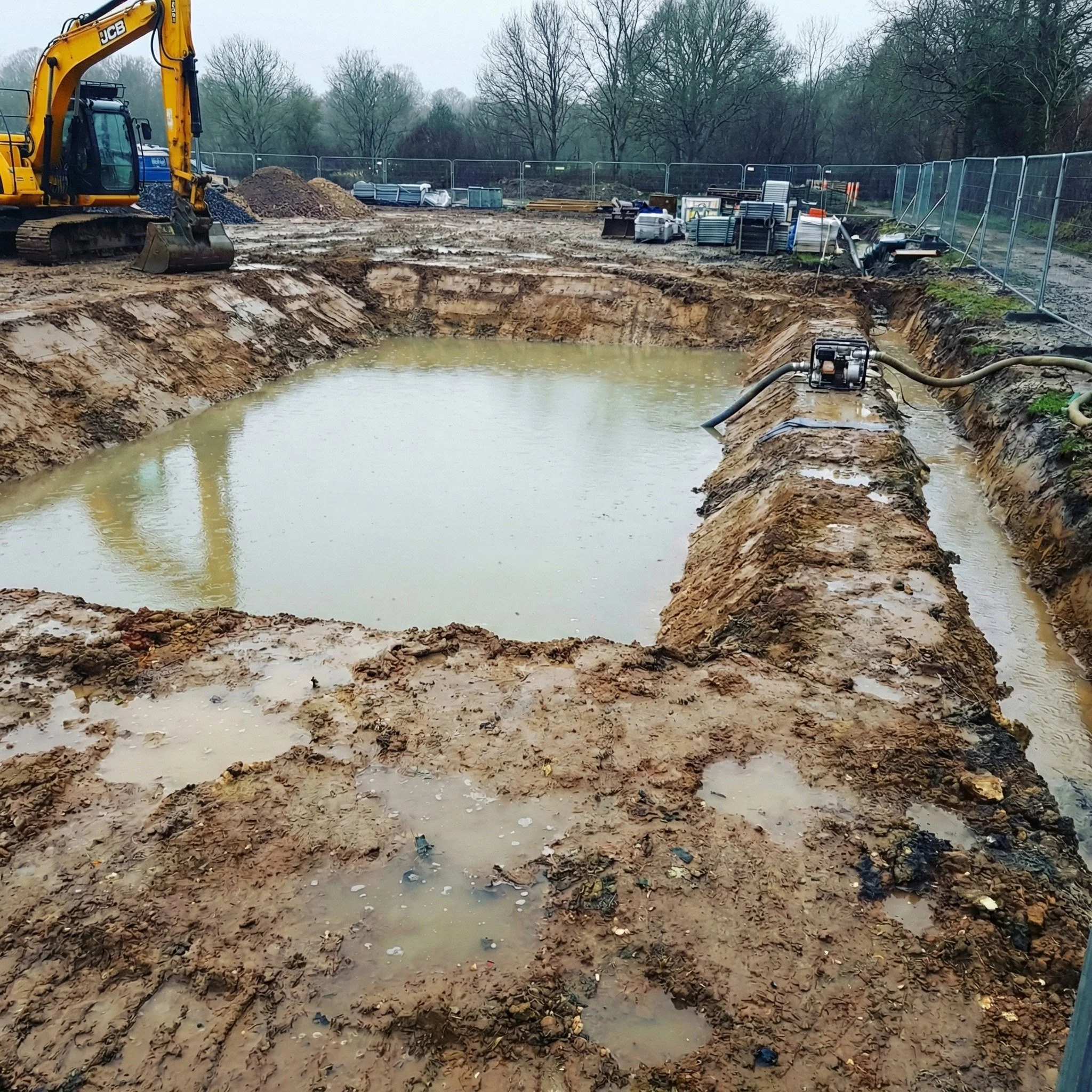
High groundwater levels are a common feature of many development sites, particularly during winter and early spring. While often discussed late in the planning process, groundwater behaviour can have a significant influence on feasibility, programme certainty, and enabling strategy.
Understanding how and why groundwater levels are high, and what this means in practice, allows risks to be managed early rather than reacted to later.
Why high groundwater levels occur
Groundwater levels rise and fall in response to seasonal weather, site geology, and surrounding land conditions.
In winter, prolonged rainfall, reduced evaporation, and saturated soils can cause groundwater to remain elevated for extended periods. On some sites, levels may stay high well beyond the winter months, particularly where natural drainage is limited or groundwater recharge is slow to reduce.
High groundwater levels are commonly encountered on:
Low-lying or poorly draining land
Brownfield and previously developed sites
Sites close to rivers, streams, or coastal influences
Areas with complex or made ground conditions
Because groundwater sits below the surface, its presence is not always obvious during early site visits, which can lead to it being underestimated.
Why high groundwater levels matter for construction
High groundwater levels affect more than surface water conditions.
They can influence:
Excavation stability and side support requirements
Bearing capacity and ground strength
Temporary works design and sequencing
Dewatering methods and discharge planning
The behaviour of contaminants within soil and made ground
If groundwater behaviour is not understood early, these issues can emerge once works are underway, increasing the likelihood of delay, additional cost, or changes to programme.
High groundwater levels at feasibility stage
The feasibility stage is where groundwater information has the greatest value.
Understanding groundwater behaviour during its seasonal peak provides a realistic picture of site conditions. This allows enabling strategies to be developed around worst-case scenarios rather than assumptions based on drier periods.
Early consideration of groundwater supports more robust decisions around access, sequencing, and earthworks, particularly where spring mobilisation is planned.
This approach helps reduce uncertainty before programmes become constrained by environmental or procurement pressures.
Churngold’s approach to managing high groundwater levels
Churngold takes a measured, practical approach to managing groundwater risk, focusing on early understanding and coordinated delivery.
1. Groundwater assessment and early risk identification
Through its groundwater management services, Churngold helps clients understand how groundwater levels are likely to behave across the winter and into spring. This supports informed decisions around dewatering, sequencing, and temporary works before construction activity begins.
2. Enabling works planned around real site conditions
Churngold’s enabling works capability allows early strategies to be shaped around actual groundwater behaviour. This includes access planning, early earthworks, and mitigation measures that reduce downstream construction risk.
3. Groundworks delivered with seasonal awareness
Elevated groundwater has a direct impact on excavation and stability. Churngold’s groundworks teams are experienced in delivering works on sites with high groundwater levels, ensuring that early planning is translated into safe, controlled site activity.
4. Supporting remediation where groundwater is high
On sites with contamination risk, groundwater levels can influence contaminant movement. Churngold’s remediation services help align remediation strategies with groundwater conditions, reducing uncertainty and supporting compliant delivery.
When to involve Churngold
Early involvement is particularly beneficial on development sites where:
Groundwater levels are known or expected to be high
Sites are constrained or previously developed
Enabling works are required ahead of spring mobilisation
Contamination risks are present
Programmes rely on early excavation or earthworks
Engaging early allows groundwater risk to be understood and managed proportionately, supporting programme certainty and cost control.
Ready to talk?
Get in touch to speak with our team.