Why groundwater matters more than rainfall in winter
A practical insight for developers, consultants, and site managers
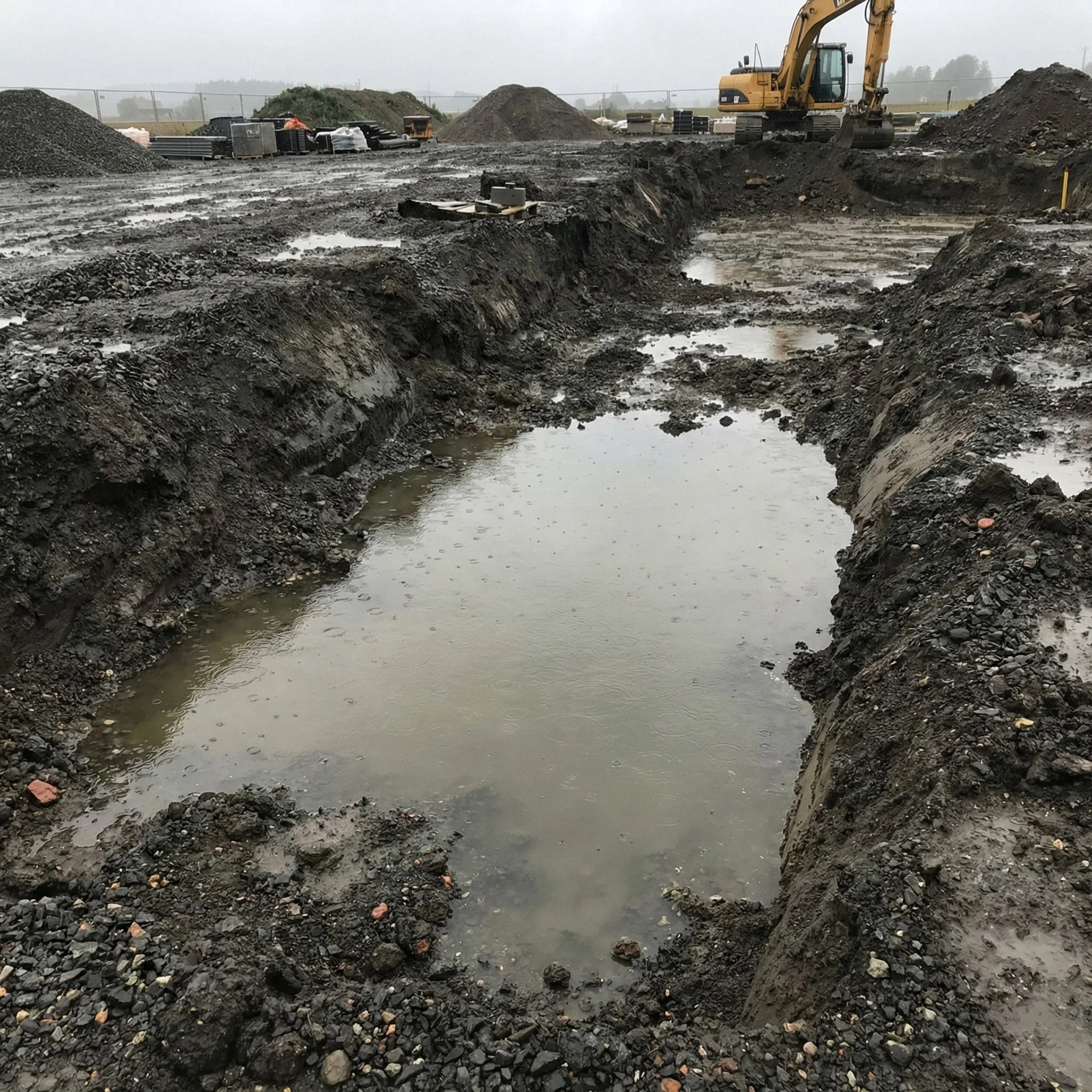
When sites become wet in winter, rainfall is often seen as the main cause of disruption. It is visible and immediate, and its impact is easy to recognise.
In reality, groundwater behaviour is usually the more significant factor.
Understanding how groundwater responds during the winter months is critical when planning enabling works, groundworks, and remediation. It is also one of the most commonly underestimated sources of early-stage construction risk.
Why groundwater is a winter risk
Groundwater behaves very differently from surface water.
During winter, groundwater levels often remain elevated for prolonged periods. Reduced evaporation, saturated soils, and limited natural drainage mean that even when rainfall eases, groundwater can stay high well into early spring.
This creates sustained pressure on the ground, rather than short-term disruption, and directly influences what can be achieved safely and efficiently on site.
Groundwater risk is most commonly encountered on:
Brownfield and previously developed land
Low-lying or poorly draining sites
Areas with historic made ground
Sites close to watercourses or with complex geology
Because groundwater is not always visible, its impact is often underestimated during early feasibility discussions.
How groundwater affects construction activity
Elevated groundwater levels influence more than wet surface conditions.
They can affect:
Excavation stability and side support
Bearing capacity and ground strength
Temporary works design and sequencing
Dewatering requirements and discharge planning
The behaviour and migration of contamination
These issues do not always become apparent until works are underway, particularly if early assumptions are based on drier conditions.
Treating groundwater as a secondary consideration can lead to reactive decision-making later in the programme.
The importance of groundwater at the feasibility stage
Winter is typically when projects move from concept into defined scope. Budgets are confirmed, programmes are shaped, and enabling strategies begin to form.
This is also when groundwater information is at its most valuable.
Assessing groundwater behaviour during its seasonal peak provides a realistic picture of worst-case conditions. Enabling strategies shaped around winter groundwater data tend to be more robust, particularly when programmes tighten and environmental constraints begin to apply.
Early understanding reduces the likelihood of delay, variation, and programme pressure later in the project lifecycle.
Churngold’s approach to managing groundwater risk
Churngold takes a practical, integrated approach to groundwater risk, focusing on early understanding and controlled delivery.
1. Groundwater assessment and early risk identification
Through its groundwater management services, Churngold supports clients in understanding how groundwater levels are likely to behave across the winter period. This helps inform feasibility decisions, dewatering strategies, and temporary works planning before works begin.
2. Enabling works shaped by real site conditions
Churngold’s enabling works capability allows early strategies to be shaped around actual groundwater behaviour, rather than assumptions. This includes access planning, sequencing, and early earthworks designed to reduce downstream risk.
3. Groundworks delivered with seasonal awareness
Groundwater conditions directly influence excavation and stability. Churngold’s groundworks teams are experienced in delivering works under challenging winter conditions, ensuring early planning is translated into safe, controlled site activity.
4. Supporting remediation in wet conditions
Where contamination is present, groundwater behaviour becomes critical. Churngold’s remediation services help align remediation strategies with seasonal groundwater conditions, reducing uncertainty around contaminant movement and control.
When to involve Churngold
Early involvement is particularly beneficial on projects where:
Groundwater levels are expected to be high
Sites are constrained or previously developed
Enabling works are required ahead of spring mobilisation
Contamination risks are present
Programmes rely on early excavation or earthworks
Engaging early allows groundwater risk to be addressed calmly and proportionately, before it affects programme certainty or cost.
Ready to talk?
Get in touch to speak with our groundwater team.